
David R. Montgomery’s “Regen” sees a new future for farming
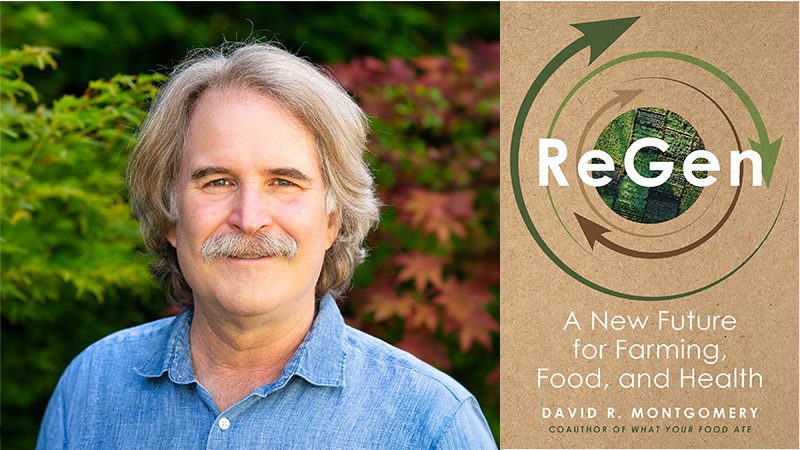
David R. Montgomery is an acclaimed geologist, but his research is literally down-to-earth.In a series of books over the past 20 years, some written with his wife, biologist Anne Biklé , Montgomery has focused on how soil health is key to farming and food. His latest publication, “ReGen,” is essentially “a capstone” synthesizing what he’s learned along the way, along with some myth-busting and practical policy recommendations.
His message: “What’s good for the land is actually good for us too. We basically need a soil health revolution in how we think about agriculture and think about the way we grow our food.” Montgomery’s cross-disciplinary perspectives includes thinking of dirt as a plant’s external stomach, and considering phytochemicals as “nature’s dark matter.”
Montgomery, a University of Washington professor, will speak at Town Hall Aug. 6 on “How to Heal Our Soil” and will speak at Seattle Central Library on Oct. 8. He recently talked with Sound Consumer editor Rebekah Denn about regenerative agriculture, geologic time, gardens, and why he remains an optimist. Here are edited, condensed excerpts from their conversation:
Q: It’s seemed widely accepted recently that regenerative agriculture is the way we should address farming. Is that just in my little bubble, or are you seeing a broader understanding and acceptance of that concept?
A: I think there’s a broader understanding and acceptance. It’s a bubble that’s growing.
The concept — that we need to farm in ways that build soil health — is not a terribly new concept. A lot of traditional and Indigenous practices have been involved in trying to promote building soil health, and the whole soil husbandry movement that even the Europeans got involved in started in the 17th century. Some of the original pioneers of organic farming, their whole intellectual framework was around soil health, they just didn’t frame it quite that way… But what we’ve learned in the last half century has solidified understanding of how you would maintain healthy, fertile soils.
(Conventional agriculture) is oriented around maximizing short-term yields in ways that have all kinds of on- and off- farm costs, and aren’t terribly efficient for farmers either, economically. People are starting to recognize the need to think a little differently about farming practices and work practices that build the health of the land and the soil.
Q: How do you define regenerative at a practical level?
A: At the simplest level, you can divide farming practices into degenerative and regenerative practices, and those would be the ones that degrade soil health and those that build and promote soil health. If you’re thinking of a 40,000-foot level definition, it’s pretty simple.
It’s complicated when you start going, what are you actually doing? And the (regenerative) practices that I’ve found, both in surveying the peer-reviewed academic literature and in visiting what I would consider to be regenerative farms around the world, are farmers that minimize or avoid both physical and chemical disturbance of the soil.
Organic farming avoids chemical disturbance of the soil. So you can think of organic farming as a potential subset of a regenerative style of agriculture, but organic farmers often use a lot of tillage, which is physical disturbance of the soil. How would organic farmers be regenerative if they’re using tillage? By minimizing the amount of tillage — and you can do that if you have additions of organic matter from compost or mulch or other ways to offset the negative effects of plowing and tillage on soil life and soil organic matter.
Minimizing or avoiding both physical and chemical disturbance would be what I would use as the definition of regenerative. If you’re doing no-till farming but you’re using a lot of herbicides to control weeds, you’re not regenerative, because you’re doing a lot of chemical disturbance even though you’ve avoided physical disturbance.
If you think about how we would sustain agriculture over the long run — and again, I’m a geologist by background, so when I mean the long run, I’m talking the long run — you have to sustain the soil and its fertility,
Q: So how do we get from where we are to where we need to be?
A: The basic recipe for regenerative cropping would be to minimize disturbance by going no or low till, keeping the ground covered with cover crops or cash crops at all times, so you don’t have bare earth, and growing a diversity of crops. Now, the problem with that vision is that it runs 180 degrees from what our government and policies have encouraged and supported and subsidized for almost a century. How do we actually do that? It’s going to require a concerted effort: from reframing policies and programs at the federal level, so we’re talking things like updating the Farm Bill, to actually promote building soil health. It would take consumer interest in promoting the idea that this style of agriculture is something we would like to support with our dollars, and it will also, frankly, take academic interest and research on how to actually do it well and how to adapt it to different farms and settings in different regions around the world growing different kinds of crops.
Basically what I’m calling for is a soil health revolution in agriculture to reorient how we think about it.
Q: You’ve written books about soil health at home. Tell me how your own garden is doing now?
A: Well, I have a brown thumb. Anne has the green thumb, so I’m the assistant under-gardener in our household, and Anne’s the uber-gardener. A couple years ago we moved from the house that we wrote about in “The Hidden Path of Nature.” That garden is still thriving with the new owners, but Anne is wrestling with the problem of restoring soil at a new location, so she’s on the second round and the garden is starting to take shape. It’s more pollinator friendly. There’s not much in the way of food growing space, because it’s a smaller space, but I’ve been really impressed with how fast Anne was able to restore fertility to the land in our yard, both in the vegetable beds at the old house and all the planting beds at both houses, when we think about how long it takes to make fertile soil.
If you ask the USDA, they’ll tell you it takes a thousand years to make an inch of soil, and that’s absolutely right if you’re talking about breaking rocks down, but if you already have the mineral matter, like we do throughout Seattle, the glaciers did it for us 15,000 years ago, and left us all kinds of sand and till and clay all over the city. That stuff is already broken up. We can add the life to it really fast.
My takeaway lesson from the garden experience at our own houses has been, we can change soil really fast if you have the mineral part. We turned the organic matter content in our yard at our old house from one or two percent to about 10% over the course of a decade. If we can do that on farms all around the world, or even in yards all around Seattle, the amount of carbon we could pull from the atmosphere and park into the soil is amazing. It’s not enough to solve the climate change problem; we have to get off fossil fuels to do that, but the more carbon we can put in the soil as a result of farming and gardening practices the better — not only for the climate, but for the garden, or for the farm, or for the farmers, or for the people who eat stuff that comes off the farms. The only people who lose are the people selling fertilizer.
Q: It’s rare for me to see someone talk about the things you’re talking about and say that you’re an optimist.
A: Well, in part, I’m an optimist by choice, because I prefer the outlook of an optimist. But what made me into an optimist on this, it was not just figuring out that it was feasible, it was seeing how the economics of farming are starting to line up behind the kind of changes that I’m advocating in terms of adopting regenerative practices. I also became convinced that in terms of agricultural production, in terms of yield, the amount of food that we can produce, it’s not a question of losing harvest to build soil health. You can maximize both.
The farmers that I visited who’ve adopted these regenerative practices, once they rebuild the fertility of their soil… you can start to see results pretty quickly. Their yields come back up to the levels that they had (through) agrochemical farming within three to five years. It depends on the farm, but to a geologist that’s incredibly fast. Now to a farmer that may be intolerably long… We should be subsidizing farmers to make the transition to regenerative practices by in effect reducing the risk for them in that transition period, because after the transition they’re not going to need the subsidies anymore.
Then the real question is, how do you encourage politicians to actually follow through and do that, and that’s not a question for geologists.
More about regenerative agriculture
Here are some common questions and answers on regenerative agriculture.
Look here for PCC’s guidelines on regenerative labels on food.
A PCC symposium in 2024 explored the future of regenerative agriculture.
Here’s a look at one of David R. Montgomery’s earlier books, “Growing A Revolution: Bringing Soil Back to Life.”
Washington State has a Coalition for Organic and Regenerative Agriculture (CORA), founded with PCC support. Read about its origins here and visit its website.