
Sharing the Harvest: Global Crops Take Root in Seattle
By Rebekah Denn | Photos by Meryl Schenker
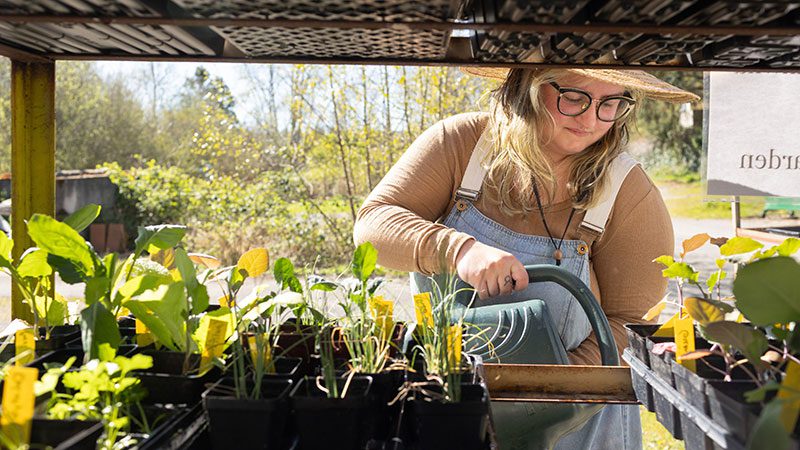
Grace Fusani of the Tilth Alliance waters culturally relevant plant starts at the Rainier Beach Urban Farm and Wetlands
In the tropical climate of the South Pacific islands, staple crops include taro, sweet potatoes, bananas and bitter melon.
None grow freely in the Seattle chill. The short growing season here makes even ripe tomatoes an annual leap of faith.
Such garden challenges aren’t always impossible. Sometimes all it takes is perseverance, experimentation — and, especially, partnership. When growers team up with community organizations, some remarkable fruits, vegetables, herbs — and connections — from all corners of the globe can grow.
Partnerships Plant Possibility
Growing up in Samoa, Toni Tupufia’s grandfather farmed a banana plantation behind their home, and her father later founded a taro plantation (see her story here).
At United Territories of Pacific Islanders Alliance Washington (UTOPIA Washington), where she is a food access network program manager, she faced a challenge: A major goal was increasing the fresh produce in UTOPIA’s community pantry to combat chronic illnesses that were common in the community. But vegetables familiar to their clients were hard to come by.
As Tupufia told a recent gathering of farmers and community organizations, “for the Pasifika community, culturally relevant food is our identity.” When people come in and see foods they are already familiar with and know how to prepare, it provides nourishment and so much more: Roots, connection, healing.
Could staple foods like taro grow here?
Through a partnership with Living Well Kent, a nonprofit whose programs include growing culturally appropriate produce, UTOPIA was able to farm a plot at Horseneck Farm near Kent.
Then partners in Portland, hearing that UTOPIA had access to a farm, offered the group taro they had obtained from Hawaii, Tupafia told the gathering. “They taught us how to take care of it so, since two years ago, we started to have kalo (Hawaiian for taro) on our farm,” a fundamental source of nourishment.
Taro roots require more months of warm weather than Seattle ever has. UTOPIA hopes to ultimately build a greenhouse that can nurture the plants to that point. But already, they are harvesting the leaves, a loved essential for dishes like palusami, where bundles of fresh young taro leaves are cooked with coconut milk. And Living Well Kent, which is working on longer-term access to farmland than its current leases, is with them on the journey.
UTOPIA is only one of the agencies that has flourished through a farming partnership with Living Well Kent. Once the agency had access to farmland, restricting it to only their own programs “didn’t feel right, and it didn’t feel like our philosophies and how community should grow. So we opened it up,” Hoda Abdullahit, community engagement director of Living Well Kent, told the audience at the food systems gathering.
Farmers who joined in included David Bulindah, who went on to start his own nonprofit, Wakulima USA, now on its own land helping farmers combine “traditional foodways” with modern farming practices.
“Whenever you take a step, think about who can take that step with you” Abdullahi said. “People will have the scarcity mindset, and I understand it… but we’ve seen time and time again, when you share and you grow together there’s way more resources, there’s enough for everybody.”
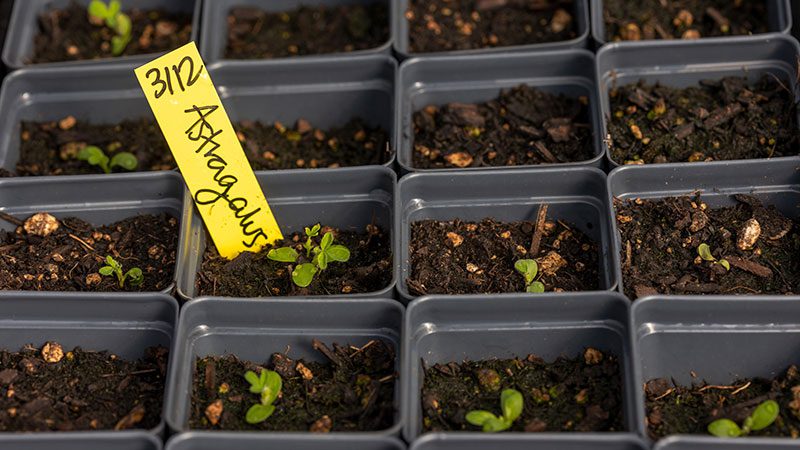
Astragalus typically prefers a warmer climate than Seattle but can be encouraged to grow here.
Seeds of Belonging
The Tilth Alliance spring plant sale is an annual rite of Seattle gardening. The nonprofit support and education organization sells everything from strawberry starts to sweet onions to squash plants.
Growing alongside those Seattle stalwarts in the Tilth greenhouses, though, is a whole other world of plant starts. They’re earmarked for community groups seeking to reproduce a taste of home.
The program began when people sought advice from the Tilth gardening hotline or other educational programs on how to grow plants that were familiar to their families but seldom seen growing locally — bitter melon or amaranth, medicinal herbs like ashwaganda or astralagus.
“We said, well, maybe we should start growing some,” said Tilth program director Laura Matter.
Tilth already sent plant starts left over from its annual sale to community groups from typically underserved communities — immigrants, refugees, senior citizens, people living in low-income housing. Many welcomed the chance to add new varieties their clients craved and knew how to grow and cook.
Among the plants Tilth took on: “Green pumpkin eggplant,” a delicacy from Myanmar. It’s a tiny, round eggplant, harvested and eaten when green, but turning orange as it ages. Also popular are edible varieties of hibiscus — a perennial shrub in Africa and parts of Asia, capable of growing as an annual here and celebrated for its tart sepals and its tender, vitamin-C rich leaves. Starchy “sticky corn,” a specialty among Hmong farmers and other Southeast Asian communities, is glutinously chewy and less sweet than typical U.S. varieties, used in classic dishes like corn cakes.
Tilth gets requests from community groups and local market sellers for these culturally relevant plants, and the staff experiments and determines “can this happen here or not?” Matter said. Often, they can, limited by budget and staff time more than climate or willingness. This year the program’s overseen by Grace Fusani, program manager for the Natural Yard Care program, which overall helps Seattleites grow healthy, sustainable gardens.
“Some of (the plants) are trickier, like okra, bitter melon, those you just have to get them in at the right time, in a really good warm spot.” Time it right, tend the plants properly, adjust as needed… and they’ve found surprising successes.
Sometimes, as with classic Asian long beans, the plants are not hard to grow here, but the plants aren’t usually stocked in local nurseries. The same was true with the green pumpkin eggplants — they do need a lot of heat, Matter noted, but what eggplant doesn’t?
Occasionally the gardeners hit a roadblock. The dry heat and cool wet of Seattle is not conducive to growing curry leaves. Tropical cassava and bananas and roots like turmeric just aren’t realistic, especially since Tilth doesn’t have heated greenhouses. (Well — you can grow a banana plant in Seattle, Matter noted — just don’t expect to get fruit from it. We don’t have a long enough, light enough, warm enough growing season.)
Fusani relies on resources like True Love, a Philadelphia-based company devoted to culturally relevant seeds, and its radio show of “seed stories.” Many resources also come from close to home, Matter said, including plants grown in Seattle’s P-Patches, with their long history of sharing resources and knowledge.
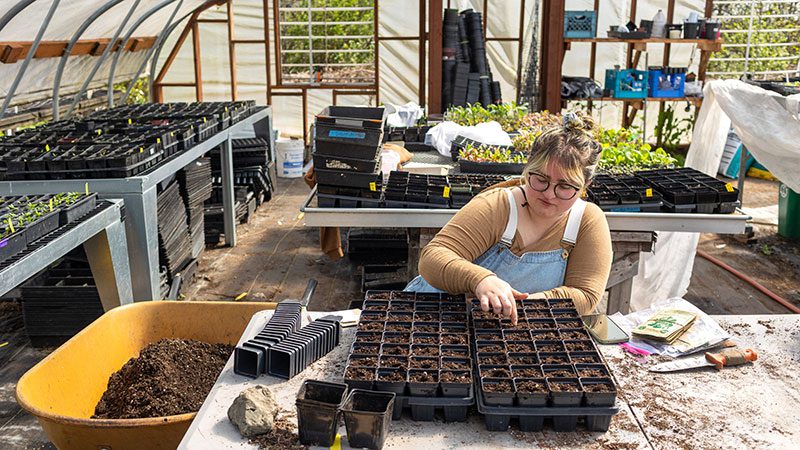
Grace Fusani of the Tilth Alliance plants lemongrass and other seeds that are less common to Seattle gardens.
The cultural relevance program grows through trial and error and word of mouth, limited only by available funding. “We’ll look up as much as we can,” but resources in English aren’t always available, Fusani said. “We have a lot of lovely partners and people that we work with who do work with those kinds of things,” like Joselynn Tokashiki Engstrom, manager of the Heron’s Nest living classroom and liaison to Duwamish Tribal Services. Thousands of starts each year, perhaps 50 of one type at a time, go out to groups that include community gardens, food bank gardens, schools, refugee aid organizations, and kinship care groups like grandparents raising grandchildren.
“Part of it’s just experience, knowing people who’ve grown it, talking to people, hearing their stories, experimenting ourselves, like okra,” Matter said. “We were like, let’s just try this. Set it out. We don’t have anything to lose. We’ll put three plants in each bin and see what happens.”
Where tropics take root
At tiny Metta Farm in Woodinville, the harvest includes bitter gourd and Malabar spinach, chayote and asparagus beans, luffa (a tropical gourd) and sweet potatoes.
Fully half the crops that the farmer, Sherry, chose for her ¼-acre “micro-farm” are native to tropical or sub-tropical climates. But, she noted in an email, “They do grow here!”
Her farm, one of the new businesses incubated at Viva Farms, a partner in Growing for Good, focuses on Asian vegetables that are less commonly found in this area. Sherry chiefly operates through a Community Supported Agriculture (CSA) program and donates produce to Hopelink.
One of Metta’s most surprising successes was water spinach, a semi-aquatic tropical vine that she said is often grown in rice paddies in Asia. Multiple farmers warned her it could not grow here, she said, but it’s done well on her farm. “I think I might be the only farmer who grows water spinach in all of Western Washington,” she said.
The plant grows aggressively under the right conditions, she noted, and is actually classified as a noxious weed in states like Florida. Here, though, our mild and dry summer is “the opposite” of its ideal conditions. So “the good news is, they will not become a weed here since our winter is too cold for them, and the first light frost will kill them off. But the bad news is, they do require some babying.”
She grew her water spinach in the greenhouse, precious real estate typically reserved for high cash crops like tomatoes.
“But in the spirit of experimenting, water spinach is also a very nostalgic vegetable for the older generation of Asians from Asia, since when times were tough when they were young, this was a delicious edible weed that people often foraged when there was not enough food to eat.”
All her tropical and subtropical crops require extra help to both survive and thrive. Rather than direct seeding them in the ground, she starts them off at home and leaves them there or in the greenhouse until the ground is warm enough to transplant.
Timing, as growers at Tilth also found, is crucial: Farmers have a narrow window to put these plants in the ground early enough to maximize yield, but not so early that they will freeze, she said. “For example, I put my bitter gourd in the ground late June last year, and it was about a month too late, and the plant did not bear any fruit until August. Although it was still at its peak production, that early October frost we had last year basically ended its season.”
Winter gourd, a larger fruit requiring a longer window of warmth, was her only failure last year. The gourds need to cure on the vine, which extends their required growing time even further.
“This year I am going to try again, but this time I got a smaller variety so it shouldn’t take as long to grow as the variety I got last year,” she said. “Fingers crossed, but I am confident!”