
Sip sustainably With PCC Collective Good teas
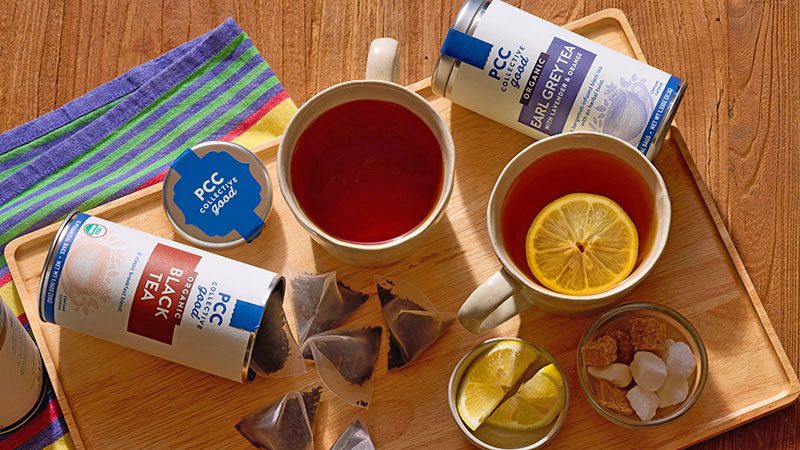
The tea is something special at Flying Bird Botanicals, but the tea bags are too.
The compostable tea bags, also used in the new PCC Collective Good line of teas produced by Flying Bird, are plant-based and do not leach microplastics, said company founder Scout Urling. The tea bags are made in Japan from a non-GMO byproduct of either tapioca or sugarcane, depending on production schedules. It’s a bit of environmental peace of mind on a topic that has nagged modern tea drinkers.
“It costs close to three times as much, but it is a non-negotiable for us,” Urling said.
Her Bellingham-based company is producing six organic “PCC Collective Good” teas — green tea, mint, black tea, an Earl Grey with lavender and orange peel, and herbal “cold ease” and “throat calm” blends, all in recyclable steel cans. The co-op partnered with the company because of its commitment to a sustainable and equitable food system, “and because the teas are absolutely delicious,” said private brands merchandiser Adrienne Chamberlain.
About Flying Bird Botanicals
As a Western Washington University student in pre-med studies, Urling learned about medicinal herbs through an apprenticeship. Later, on a trip to Guatemala, she became friends and collaborators with a group of women reclaiming native herbs there.
Tea became an accessible way to work with herbs – and a balance between “getting all these herbs you know are good for people into blends and making it taste good.”
She started the business casually with looseleaf teas at a farmers market in 2006, growing and drying many herbs from her own yard. It took off around 2015 after expanding into tea bags.
“We definitely took the tortoise route. We’ve never taken any kind of funding,” Urling said. That’s also allowed them to stay true to their mission and their carefully blended formulas, without pressure to make them more profitable.
Some ingredients in the certified-organic teas are now sourced from fair trade or direct trade growers overseas, like the large quantities of ginger that are difficult to grow at a commercial scale in the U.S. But many are still grown locally — starred ingredients on the tea label indicate if they’re grown in the U.S. — including all the peppermint and spearmint.
Urling has worked with the owners of one farm almost since she moved to Washington. Now located in Port Angeles, Flying Bird sources from that farm “all the things that grow here — maybe not in huge quantities — lavender, peppermint, spearmint, lemon balm, hawthorn flowers, oat straw and I’m sure there’s more.” Northwest farms also produce hyssop and calendula.
PCC Collective Good teas
People tend to drink teas for two distinct purposes, Urling notes – either as a pick-me-up or as a way to relax.
For herself, she drinks a breakfast tea each morning with a bit of cream and honey. She’s also a particular fan of the Cold Ease, with lemon and honey, regardless of whether she has a cold.
A top Flying Bird seller is the lavender orange Earl Grey: “Bergamot is a very floral citrus,” she said, and the lavender highlights the floral side while the orange peel highlights the citrus. “You get this kind of enhanced version of Earl Grey.”
Generally, “I love using orange peel in different things because it’s got such a nice sweet and tangy flavor, and it’s also good for you. Rose hips are like that too — a sweet and tangy flavor, packed with Vitamin C and other minerals and vitamins. Then you taste, taste, taste, taste and find the right blend.”
No ingredients or recipes had to be altered to meet PCC’s quality standards for the private label teas, Urling said
“We are who we say we are,” she said. “There are so many people who use a lot of buzzwords or chose to be organic for the marketing or because they think they’ll make more money, but were doing it because everything we do is dictated by what we think the right thing to do is…
“People always ask, ‘how do you make decisions?’ and it’s “People and Planet.” If you always go back to those fundamentals, the decision making is always pretty easy.”