From Grain to Sausage: Inside the Washington Farm Behind PCC’s Pork
On a single family farm in Eastern Washington, it’s possible to see the origins of PCC’s sausages and other pork products from beginning to end.
That comprehensive life cycle is rare in the modern meat industry, where any significant pork production is dominated by factory farms owned by monopolies, raising chronic concerns about animal welfare and pollution.
At Pure Country Farms in Ephrata, the pork is “amazing, delicious and produced by the farmer, as good as it gets,” said Erik Lind, meat and seafood manager for PCC. The farm now supplies 98 percent of the fresh pork sold at PCC Community Markets, including the co-op’s new PCC Value sausage.
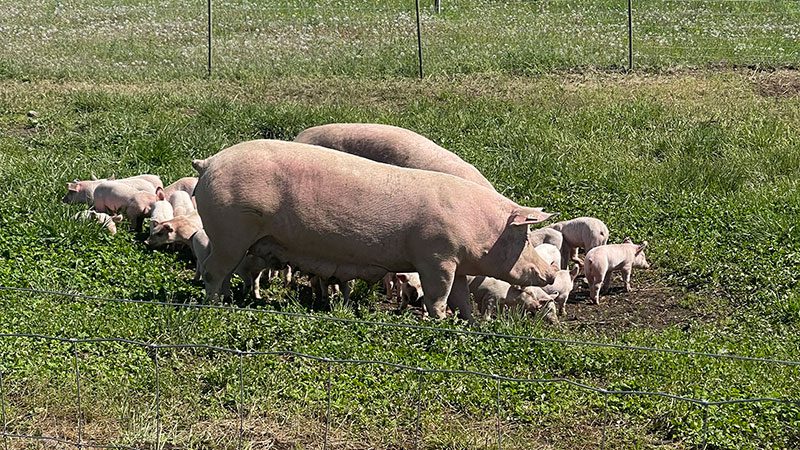
Barley stalks and other ripe grains wave in the fields. Young pink piglets — raised on feed made with those grains — root and run around their outdoor enclosures, taking breaks for water and shaded naps.
Once grown, the pigs are harvested at Pure Country’s certified U.S. Department of Agriculture (USDA) facility in nearby Moses Lake, processed and packaged on site and shipped to the co-op.
For PCC, the decades-old relationship provides a local, transparent supply chain that meets its quality standards. For Pure Country, PCC provides steady demand and a local partner with shared values. PCC is Pure Country’s only retail partner; its other major clients include Preservation Meat Collective, which supplies fine Northwest restaurants and other clients.
Pure Country also stands out for its transparency in an era of industrial secrecy and “ag-gag” laws. Co-op staff recently visited the farm and were invited to tour every corner, to meet the family and the farm’s workers, to see the fields and animals’ living conditions. They literally saw how the sausage is made, observing as hogs were harvested, processed and prepared for wholesale and retail sales.
“There’s nothing to hide,” said farmer Paul Klingeman Jr.
A 4-H project out of hand
Standing beside a mill on the 160-acre Ephrata farm, Klingeman Jr. described Pure Country as “a 4-H project that’s gotten out of hand.” It was a joke, but only partly, on an operation that now raises about 6,500 hogs and 1,800 cattle per year.
His father, Paul Klingeman Sr., who also joined the tour, began raising pigs as a teenager, participating in 4-H youth agriculture programs and Future Farmers of America.
Pure Country is not a boutique operation, but it’s nothing like a modern commodity farm. Klingeman Sr. worked for super-sized operations early in his career and couldn’t support the way animals were raised there. Profits, they decided, couldn’t be the reason behind every decision.
“We try to find the best happy medium,” Klingeman Jr. said. “What’s best for the animal, what’s best for the consumer, and what’s best for the environment.”
The day began at Pure Country’s feed mill, where non-GMO peas, barley and other grains are ground and blended into custom rations. Depending on crop yields and rotations, the farm grows between 70% and 90% of its own feed ingredients. Selling animal feed to other farmers has become part of Pure Country’s business model too.
“Peas are super-important, peas are your protein. We actually use a sweet pea,” Klingeman Jr. explained. “Pigs are amazing, because you can change the flavor so much in the meat” depending on what the animals eat.
The feed formulas are adjusted as animals grow and conditions change. Even the grind size is altered depending on which animals are eating it, with younger pigs receiving finer, more digestible portions.
“We work with the nutritionist every two weeks….,” Klingeman Jr. said. “If I had wheat in this field and wheat in one field over, the test could be different. It could change 1% in protein level. It could change the lysine level. So we’re continuously testing that, to try to always make a good, consistent product.”
Everything begins with healthy soil. The farm relies on practices associated with regenerative agriculture, including double-cropping and no-till farming, which preserves deep root systems that break up compacted soil, decreases soil erosion and water runoff and improves the soil’s microbial life.
“If we dig out here, we’re going to find worms,” he said.
Certifications back up their practices: Pure Country was the first meat vendor in the United States certified by the Non-GMO Project. In 2007, Pure Country also earned the first certification for sustainable hog farming from the Food Alliance, a third-party certification overseeing working conditions, humane treatment of animals and environmental stewardship. They haven’t sought organic certification; Klingeman Sr. said he preferred the alliance’s focus on worker and animal welfare.
Touring the property, the group drove past cows grazing in the Ephrata fields. That’s rare in the beef industry, commented Sean So, co-founder of Preservation Meat Collective. “Most cattle won’t spend a single ounce of their day on pasture. They literally get born and put onto a feed lot.”
In the summer, the cattle move to mountains and grassland farther north, while Pure Country plants rye, triticale and other crops on the Ephrata land. The cows are ultimately grain-finished back in Ephrata.
How pigs are raised at Pure Country
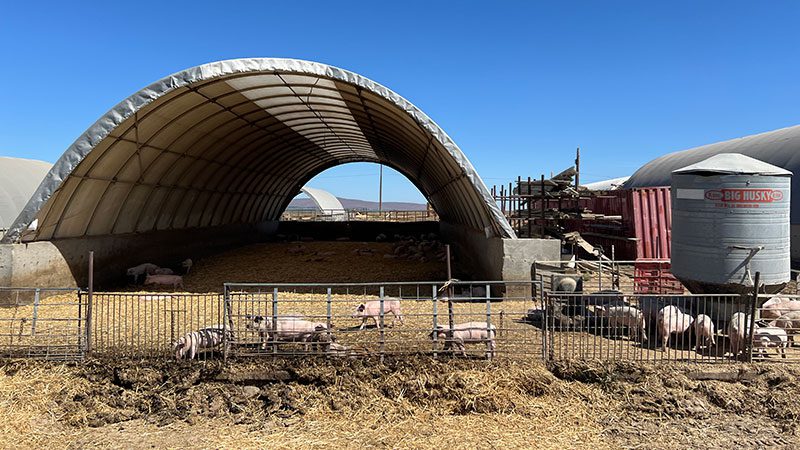
While some sows browsed the grass with nursing litters, the majority of the Pure Country pigs are raised in covered hoop structures.
”In early morning, they’re out here sunning themselves. As it gets warmer, they start moving in the shade as it gets hotter. In the afternoon, then the big overhead sprinklers out front will be on,” Klingeman Jr. said. In winter, the crew stacks hay bales to block the wind. “They’ll still come out play in the snow, a little bit of rain.”
Straw bedding is replenished daily, ultimately layered with manure and renderings from the plant and turned into compost for the fields. “We use no liquid nitrogen, no urea, none of that stuff on our fields to grow our crops. It’s kind of a whole circle,” Klingeman Jr. said.
The animals are raised with a focus on reducing stress, including innovations like teaching young pigs to walk themselves through gates and chutes and step on weighing machines.
“You make a ramp long enough that it’s nice and easy for them,” Klingeman Jr. said.
The farmers constantly watch the growth curves and what the animals are eating, which can change depending even on factors like weather. “Mother Nature throws us off all the time on that a little bit, you know?.. We can change that pig’s ration 20 times throughout its life cycle,” Klingeman Sr. said.
Learning to walk through the chutes calmly ultimately helps the pigs at the end of their lives. “Our animals aren’t getting hauled very far, they’re not having stress when they’re getting hauled,” he said. That’s meaningful for both animal welfare and for quality control, meaning the meat isn’t degraded by adrenaline and cortisol.
About 30 pigs go through the harvesting facility daily. Different clients use different parts of the animal, creating a synergy that reduces waste. Preservation Meat’s owners, for instance, also own Jack Mountain Smokehouse, where they make ham from Pure Country’s pigs. (PCC is the exclusive retailer of Jack Mountain products in the Seattle area.)
“They’ve created an economical, sustainable Washington pork,” Lind said – an anomaly. And along the way, they’ve kept it all close to home.