
What it takes to save the Northwest’s iconic whales
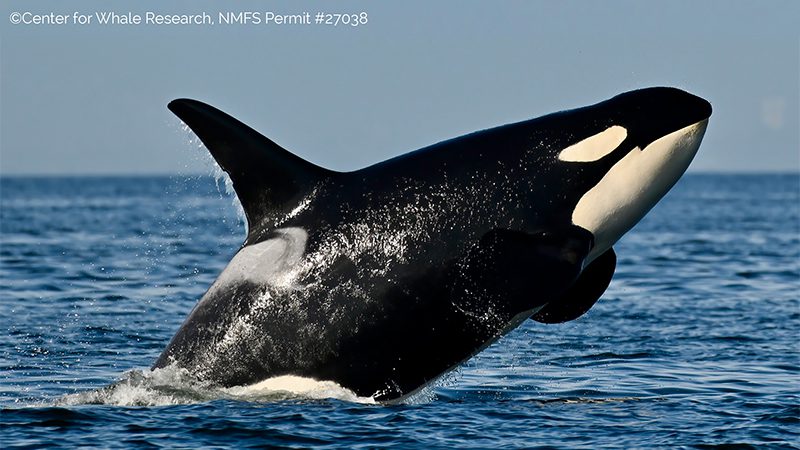
At 3:28 p.m. on a Monday earlier this year, researchers made a rare and exciting discovery — a new orca whale calf swimming with a pod of whales near Sooke, B.C. For nearly an hour, they tracked the movements and behaviors of the whales, identifying them as members of “L pod,” one of three local Southern Resident pods.
For the nonprofit Center for Whale Research (CWR), it was one more data point — a small, uplifting moment in a record that has stretched, uninterrupted, for nearly 50 years.
That record now carries an urgent message: only 74 Southern Resident killer whales remain.
50 years of watching every whale
The Center for Whale Research, based in Friday Harbor, is marking its 50th anniversary this year. For half a century, scientists there have conducted the Orca Survey — a continuous effort to identify and monitor every Southern Resident killer whale, as well as other populations that pass through regional waters. The members of L pod observed by researchers earlier this year, for instance, included one known as L55, a grandmother who is believed to be 49 years old, born shortly after the survey began.
The survey, an extraordinary unbroken record, is considered one of the most complete sets of data ever assembled for a wild mammal species. It’s provided crucial information on the species and on our environment.
“Tracking every individual across every year has transformed our understanding of killer whales and reshaped conservation efforts throughout the Pacific Northwest and beyond,” Darren Croft, executive director of the Friday Harbor-based organization, said in a statement.
Croft will speak at a meeting with PCC members later this month (see below) about the center’s work. Co-op members and shoppers have been an important part of its support, raising more than $100,000 for the nonprofit in 2025 alone. Funds are donated through purchases of Cards by Lodie, whale-themed greeting cards sold at PCC stores and created by CWR staff member Lodie Gilbert.
And yet, the 50th anniversary is more than a celebration. It is “an opportunity to look forward and a commitment to securing a future in which Southern Resident killer whales can recover and thrive,” Croft said.
The orca population may be among the most studied on Earth, but it’s also among the most endangered.
What are Southern Resident Killer Whales?
The Southern Resident killer whales are a distinct population of orca whales, comprising three orca populations that share similar migratory and feeding patterns. The three pods (J, K and L) inhabit a territory stretching from British Columbia to California. Each summer, they are typically found swimming and feeding in the Puget Sound and the nearby interior waters of British Columbia.
But it is not only their migration route that sets the Southern Residents apart. Unlike other populations of orcas that eat mammals (such as seals), Southern Residents only eat fish, mostly salmon, and a large majority of that is Chinook salmon.
The Orca Survey began on April 8, 1976, when marine biologist Dr. Ken Balcomb encountered a group of Southern Resident killer whales near Port Angeles in the Strait of Juan de Fuca.
Very little was known about killer whales at that time. Orcas were widely misunderstood, often portrayed as dangerous predators rather than highly social animals with rich family lives and distinct cultures, Croft said.
“At the same time, the Southern Residents themselves were under enormous pressure. During the 1960s and early 1970s, many young whales from the population were captured for marine parks and aquariums. Families were disrupted, individuals were lost, and the population was pushed toward decline before scientists fully understood who these whales were.
“What emerged in response was a revolutionary approach to wildlife science. Working alongside pioneering scientist Dr. Michael Bigg, Ken and his team identified individual whales through photographs of their dorsal fins and saddle patches. This photo-identification method was a major scientific breakthrough. For the first time, researchers could recognize and follow individual whales across years — and eventually decades.”
 Photo courtesy of the Center for Whale Research
What we’ve learned about Southern Resident Killer Whales
Researchers soon discovered that Southern Resident killer whales live in stable matrilineal families, with sons and daughters remaining with their mothers for life. Pods were found to maintain distinct vocal dialects and social traditions passed from generation to generation, Croft said.
Another remarkable CWR finding was the discovery that female Southern Resident killer whales go through menopause – an exceptionally rare biological phenomenon among mammals. The long-term research also revealed “the critical importance of family relationships to survival and reproduction. Older females play a vital role in guiding and supporting younger relatives, particularly during periods of food scarcity.” That, in turn, helped scientists better understand the evolution of social behavior, aging, and longevity across species — including humans.
“Scientists at the Center for Whale Research were no longer simply studying a species. They were documenting a society in which every whale is known individually by name and family history,” said Croft.
“These whales are not anonymous data points in a declining population. They are mothers, sons, grandmothers, calves, siblings, and matriarchs whose lives have been followed across generations. The longevity of the Orca Survey has made discoveries possible that shorter studies could never uncover.”
Another, far grimmer finding: That society is under continuous, severe strain.
Over the last half century, the Center has tracked 224 individual whales, documenting 149 births and 144 deaths, said Croft.
At the point of the last official census, only 74 Southern Residents remain. It remains to be seen whether the energetic young calf discovered earlier this year, identified as L129, will survive the season.
Their dwindling numbers have been attributed to loss of critical habitat and crucial food sources.
How Chinook salmon are connected to the whales
Decades of demographic data established that Southern Resident killer whales depend heavily on large Chinook salmon as their primary food source. As habitat for salmon declines – and the fish along with it – so do their predators. Restoring the rivers that sustain Chinook salmon, Croft said, is critical to save the whales. (PCC created new quality standards around selling Chinook salmon as part of this issue.)
For the Center, scientific understanding carries responsibility. The nonprofit is increasingly pairing scientific leadership with direct ecosystem restoration and conservation intervention.
In 2020, for instance, Balcomb purchased 45 acres along Washington’s Elwha River to establish Balcomb Big Salmon Ranch — a project dedicated to restoring and protecting critical Chinook spawning habitat. Restoring rivers like the Elwha represents one of the clearest pathways toward long-term recovery of the population.
Partnerships like the longstanding connection between PCC shoppers and CWR matter too, where 100% of each card sale is donated to the center. The partnership gives PCC shoppers a meaningful way to directly support whale research and related efforts – but also represents a shared belief that environmental stewardship is not separate from everyday community life, Croft said.
“Fifty years of continuous study have reinforced a fundamental principle: understanding populations begins with understanding individuals. The power of the Orca Survey has always come from documenting every whale, every family relationship, every birth, and every death across generations.
“That same principle extends beyond the whales themselves. Recovery depends on every researcher collecting data in the field, every partner helping restore salmon habitat, every policymaker willing to act, and every community member choosing to support conservation efforts in meaningful ways.”
Learn more about the Center for Whale Research here.
Learn about orca research
PCC members can learn more about the Southern Resident Killer Whales at a free online event at 5:30 p.m. June 30. Darren Croft, executive director of the Center for Whale Research, will speak about more than a half-century of research findings along with a look at future threats and projects to address them. Sign up online here.