Can seafood be organic?
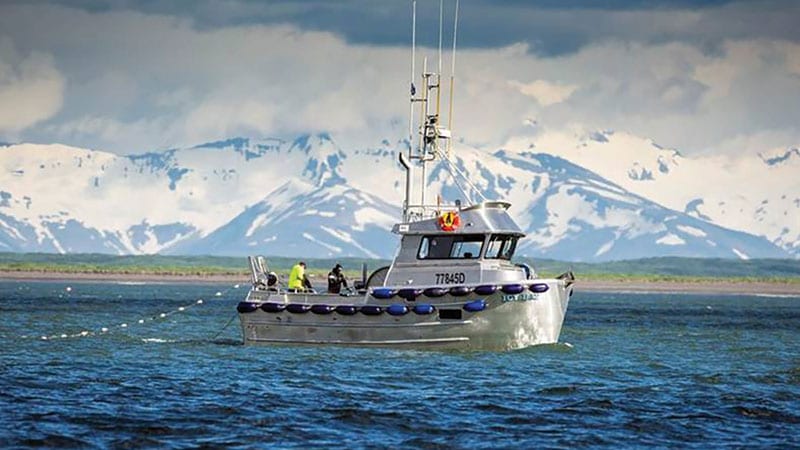
Photo courtesy of SalmonState
Seafood is one of the most confusing categories for consumers trying to eat sustainably. And shoppers who use the USDA Organic label to guide their purchases can’t—yet—rely on that certification for seafood. Some “wild crops” from the ocean can be certified as USDA Organic, such as kelp and seaweed, but fish are not among them. There are practical reasons for the labeling gap, but other roadblocks are issues of politics and timing.
Is there any organic certification for seafood?
Various labels exist governing sustainable seafood, but USDA Organic—the only government-backed organic certification in the U.S.—is not currently among them. Seafood labeled as “organic” is almost certainly imported from other countries working under guidelines that the U.S. lacks in its own organic program. For instance, Canada allows organic certification for its farmed seafood, and an agreement between the U.S. and Canada allows their organic products to be labeled and sold as organic in both countries, within certain restrictions.
Will seafood ever be certified organic?
The odds that seafood will ever be certified as USDA Organic are different for wild fish and farmed fish.
By nature it is difficult to certify wild fish. The USDA Organic standard regulates what creatures eat and what affects their environment. It’s possible for farmers and regulators to quantify whether apple trees have been sprayed with chemical pesticides, for instance, or whether chickens have been treated with antibiotics. But it’s impossible to fully control what wild fish eat and what substances they’re exposed to as they travel through water.
Despite those limitations, the federal government has considered whether to certify wild fish as organic since the program’s earliest days. As far back as 2003, Congress included the option of certifying wild fish as organic if regulations could be developed. Discussions ebbed and flowed over the years; most recently in 2021 when Congress urged the National Organic Program to restart considering whether wild fish could be certified as organic. PCC staff testified extensively about the co-op’s concerns at a subsequent USDA “listening session,” full PCC comments are online here. So far, there’s been no public follow-up. There have been no recent recommendations or other indications that certifying wild fish is a current federal priority.
Farmed fish once had a clearer pathway to organic certification. The USDA announced in 2015 that it intended to propose standards for organic farmed fish later that year. The proposal never materialized. If it had, the idea likely would have faced significant opposition.
Goldie Caughlan, the longtime PCC educator who served on the National Organic Standards Board, wrote in 2009 that an early proposal for organic farmed salmon was “sad and shocking” and counter to the board’s mission. Her opposition included concerns about certifying open-net pens, which she considered the seafood version of factory farms.
She was far from alone. The concept of certifying farmed fish as organic has drawn significant blowback over the years from many stakeholders. The Environmental Working Group, a nonprofit organization, called the idea “a contradiction in terms.”
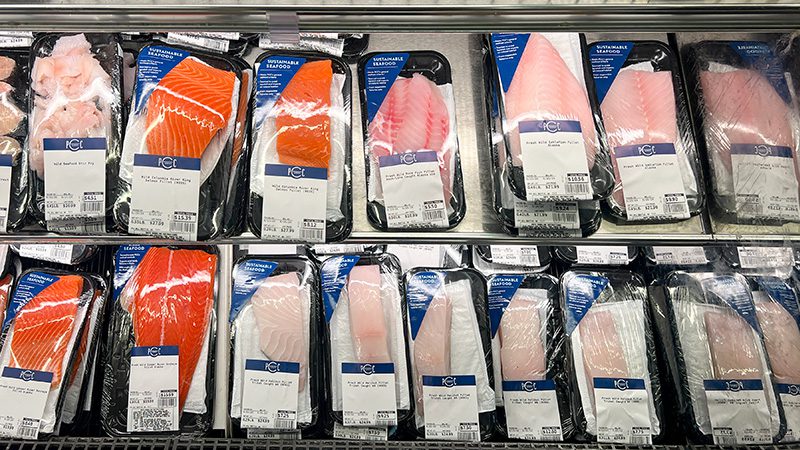
All seafood sold at PCC stores is subject to strict quality standards.
How to find sustainable seafood
USDA Organic seafood is not currently an option, but many other labels and standards exist. The Monterey Bay Aquarium’s Seafood Watch program has been widely adopted, including its popular Seafood Guide ratings. The respected Marine Stewardship Council certification governs wild fisheries. PCC has developed extensive quality standards governing its seafood, including that:
- PCC will not sell any fresh and frozen raw seafood that is rated an “Avoid” by Seafood Watch, with the exception of Chinook salmon, which has its own PCC standard (see below) that differentiates between fisheries at a deeper level.
- PCC will not carry any seafoods known to be high in mercury or other contaminants.
- PCC does not sell fish (e.g. Atlantic salmon) raised in open-ocean net pens that damage the environment.
- The majority of PCC’s seafood comes from the U.S., in part to avoid illegal fishing and exploitive practices in other parts of the world.
- The co-op developed a separate standard just for Chinook salmon to avoid impacts on the region’s Southern Resident Killer Whales.
- For more information, see PCC’s frequently asked questions on its seafood standard.