The ripple effects of Growing for Good
By Rebekah Denn, photos by Meryl Schenker
What does it mean to support Growing for Good by rounding up purchases at PCC registers?
Since Growing for Good began in 2020, over $1.3 million has gone to local farmers to grow food for hunger relief organizations including neighborhood food banks, meal programs, healthcare centers and school-based programs. Some 95% of the funds raised to make this happen were donated by PCC shoppers and individuals who provided direct one-time or monthly donations.
Growing for Good gives local farmers advance payments in the spring so they can invest in seeds and supplies at a time when they need the money most. Farms are matched with food banks and other hunger relief organizations who order the fresh, culturally relevant foods their clients need most.
Visiting the participants, it’s clear the program’s effects ripple beyond money or sales. Growing for Good has helped farmers save or stabilize shaky businesses, add new harvests, change business models, allow aging parents to retire, feed people in better ways.
It strengthens the whole community.
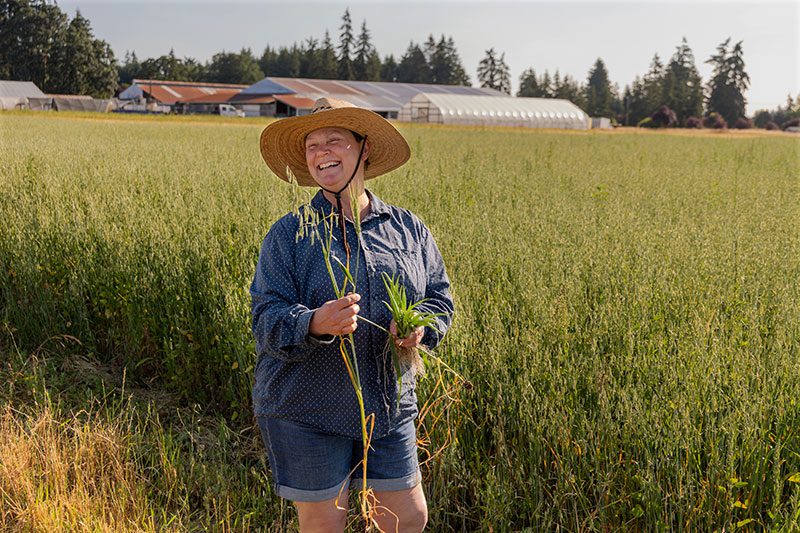
Genine Bradwin starts the day at Kirsop Farms waving a flag to shoo chickens in the right direction as her husband, Colin, uses a tractor to haul their mobile hen houses to a new patch of pasture.
“The sheep go ahead of the chickens, and they cut the grass down,” she explained. “The chickens want fresh grass and clover and pasture to eat every day, they don’t want it to be knee-high.”
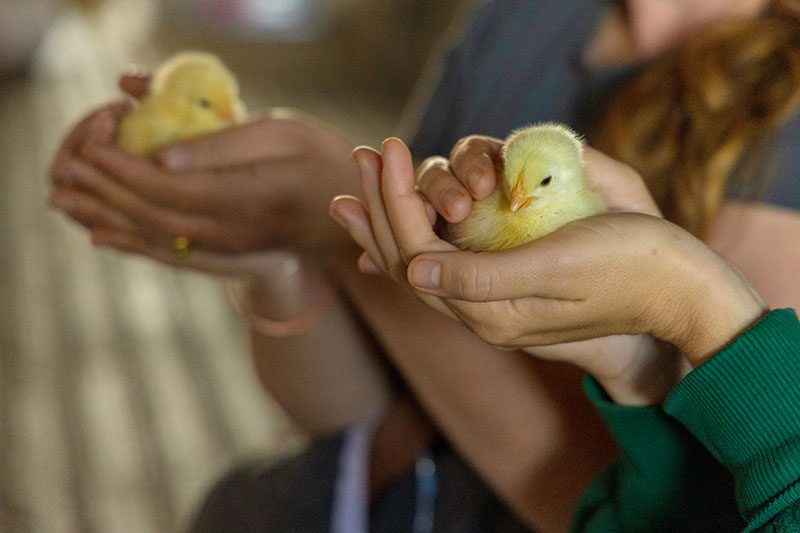
Baby chicks live in the Kirsop barn for three weeks, then live on pasture for the next five.
The certified organic farm supplies five agencies through Growing for Good — Rainier Valley Food Bank, White Center Food Bank, Highline Area Food Bank, Asian Counseling Referral Services, and the Pike Place Market Food Bank. “Because our farm does both (produce and chickens), we offer both, and then the partners get to choose what they want,” she said. Organic chicken is an expensive protein, one that’s rare for hunger relief organizations to procure. Growing for Good allows them that choice — and the stability of the Growing for Good orders and the early season payments allowed Kirsop to add a processing facility to add chickens to the farm’s diverse business mix.
Kirsop is a “complicated” farm, Bradwin said. It has to be, to stitch together a sustainable business over the 30 years since it began on a single acre. Colin began the farm as a vegetable CSA. Genine was one of his first customers, then later his partner in work and life. Year by year they made new additions to allow them to farm as a career rather than as one of a patchwork of part-time jobs.
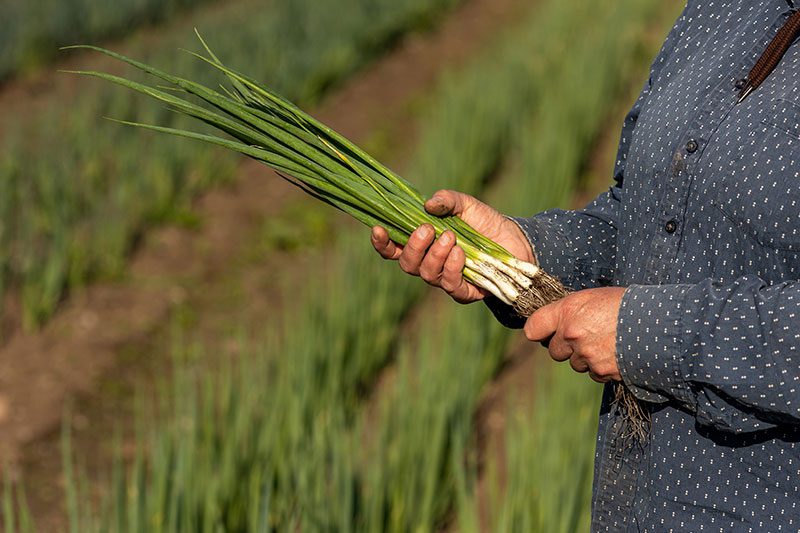
Now, the couple grows some 50 varieties of vegetables on 12 acres, scallions to celery root to potatoes to the carrots that made them famous at local farmers markets. “You just have to make sure that the soil has every little possible thing to make a good carrot, and then you can make a good carrot. You can’t skip any of the steps,” she said. A cover crop that went to seed ultimately led to buying a combine and harvesting grains, including perennial buckwheat, wheat, barley and now hulless Streaker oats that are rolled on site. Bradwin tests one of the shimmering oats dangling from a stem to see if it’s at the brief stage where she can trial a batch of milky oats tea, which is said to reduce stress. “All of the varieties of grains that we’re growing are — I don’t want to say rare, but they’re not common in mainstream production because they’re designed to mature quickly in our short growing season and to do well in our cooler climate and to be tasty.” The couple raises organic chickens — and processes them on site, “almost a separate business,” into meat and farm-simmered bone broth. They maintain a flock of sheep, both for meat and for wool that’s processed into yarn and hides tanned into sheepskin — three other businesses. The couple likes a variety of work, and the combined income streams are what makes the farm sustainable.
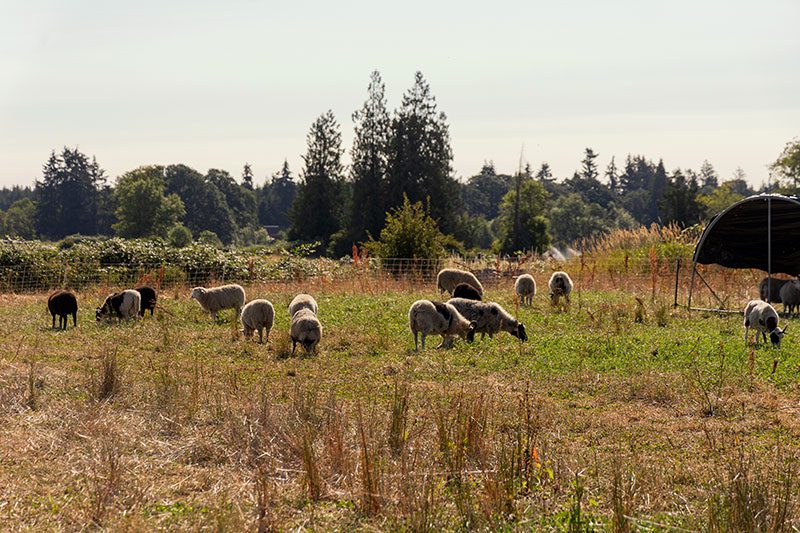
Bradwin was one of the first farmers to join Growing for Good, and it now makes up about 20 percent of the farm’s business, giving Kirsop more stability and more breathing room.
“It has replaced a farmers market,” she said. “By making deliveries through the Growing for Good program, having that income, that means I don’t have to load up and go to a third farmer’s market” each week.
That allows for more of the day-in and day-out chores, solving the puzzle of “the right amount of income from the right amount of crops with the fewest number of employees that we need.”
The work is ceaseless, but what keeps her at it are the same things that always have. “I love pulling weeds. I love planting seeds. I love watching things grow. I love eating. I really love eating. In some ways, I see the farm as an extension of the kitchen.”
The farm rests on 60 acres by the Chehalis river, in an agreement with a land conservancy that ensures it will be farmed in perpetuity. It’s a good thing, Bradwin said, and all she and her husband ever wanted to do.
OJ’s produce
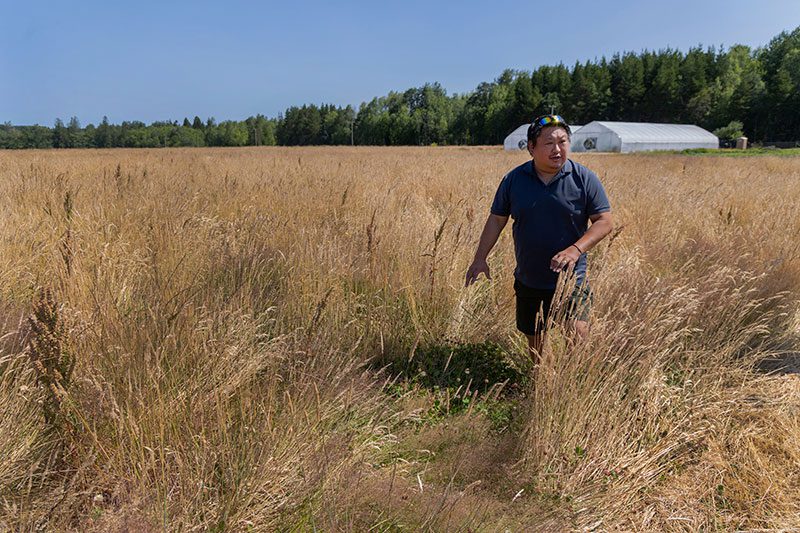
About a half-hour drive from Kirsop Farm, Cania Lee surveys the fields of OJ’s Produce, his family farm in Ethel, WA.
His parents, as well as other relatives in the Hmong farming community, started growing vegetables in Snohomish County more than 30 years ago before moving south for access to better water and reduced flooding. Cania worked in the fields with his extended family for years, then went to business school, taking on the full farm responsibilities in 2018.
The business originally focused on wholesaling vegetables, mostly to sellers in Seattle’s International District.
But the high-pressure farming depleted the soil, requiring expensive correctives and spiraling into a burdensome cycle, especially as prices skyrocketed after the COVID-19 pandemic. “The more I produced, the more I lost…,” Lee said.
His parents told him “You got to make some hard choices. Do you want to sell the farm? Do you want to quit? And I was just like, I got to find a different solution.”
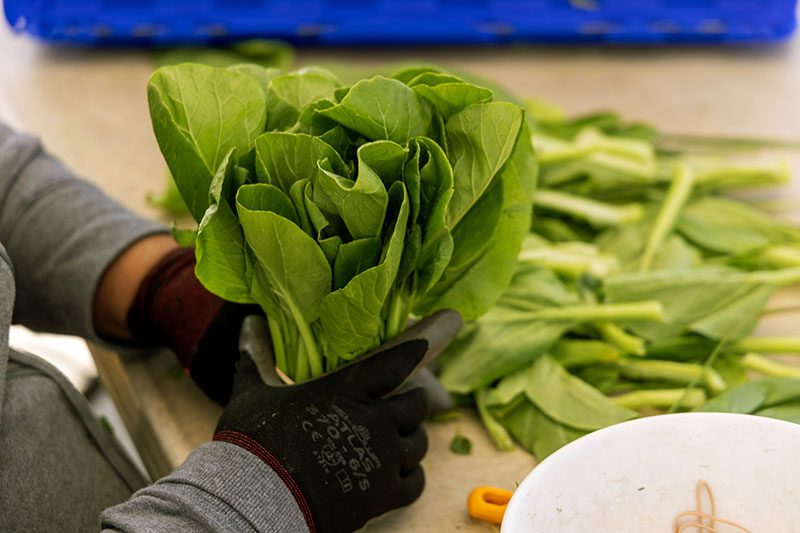
He joined the waitlist to sell at Seattle’s Neighborhood Farmers Markets — a competitive opportunity where it took time to get in the door. At the same time, Growing for Good was looking for a farmer who specialized in Asian greens, and invited him into the program. Now, Growing for Good makes up about 15 percent of his business, in addition to his farmers market stands.
Cover crops of perennial rye and clover and “pasture seed” of perennial grasses now help rejuvenate the soil on fields that had been cultivated in the past. “I won’t even touch this one for another 2-3 years,” he said, showing one that already had seen its last harvest two years ago. His rows of specialty crops focus on Asian vegetables such as bok choy and Chinese broccoli and chrysanthemum greens. In covered greenhouses, pots of cucumbers twine alongside herbs like lemongrass, along with tropical niches including banana palm leaves and loofas.
“My mom’s kept some of these herbs alive for decades,” he said, some used in traditional home remedies such as a nourishing post-partum soup.
He’s cut his harvest by about 60 percent, but says his business is immeasurably better.
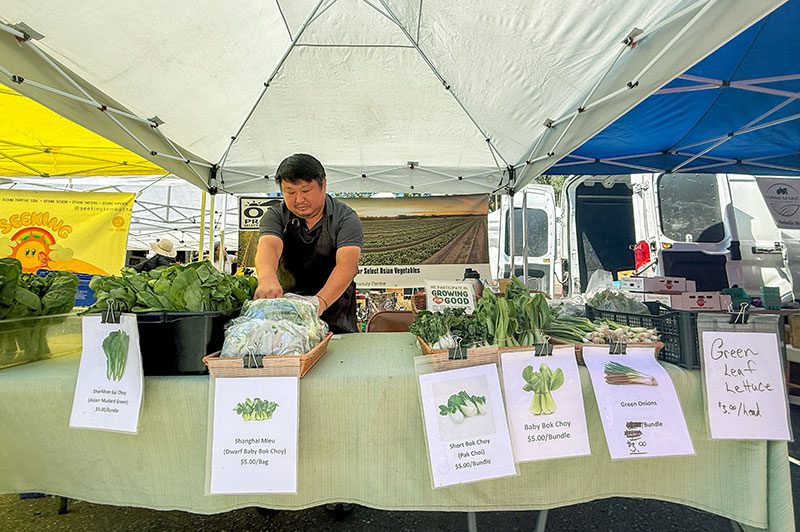
“It’s been probably the biggest blessing because it’s allowed me to be a better steward of land,” he said. “We were literally killing the soil, our bodies, breaking equipment to meet up for wholesale production, and we were doing it all on pennies on the pound.”
He and his crew packages the harvest at the farm now, and he knows exactly who his customers are for each crop. Multiple farmers markets can become grueling for the crew, so the Growing for Good deliveries provide a welcome balance.
“When I was doing wholesale… we fed thousands and thousands of people from this farm, and I didn’t know who was eating it. I didn’t know where it was going. I just knew it was being absorbed and it just needed more, and there wasn’t enough… and this is what most farmers are dealing with,” he said.
He still has sleepless nights. Unforeseen snares regularly crop up like diesel prices shooting up with the Iran war.
Still, at his farmers market stand, he tells people about Growing for Good. He urges shoppers to support the non-profit, tells his fellow farmers to apply, and suggests hunger relief organizations join in. The Food Bank at St. Mary’s became a participant this year through his efforts.
“It’s been a blessing because literally I’ve never felt so good about what I do as a farmer than Growing for Good,” he said. It’s helped him farm in a more sustainable way, both environmentally and financially — and it’s allowed him to grow food for people who couldn’t afford it otherwise but might need it most.
“My job as a farmer is to feed people,” he said.
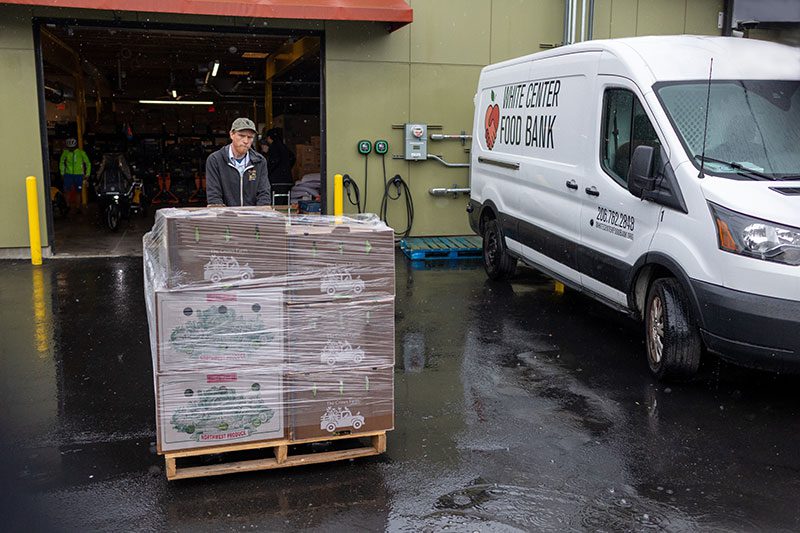
White Center Food Bank
Both Kirsop and OJ’s send deliveries to the White Center Food Bank, but on this particular summer day the Growing for Good order is coming from nonprofit Viva Farms. Viva offers a bilingual education program on organic farming and serves as a business incubator, with more than three dozen small organic farms getting their start on its land in Skagit and King Counties.
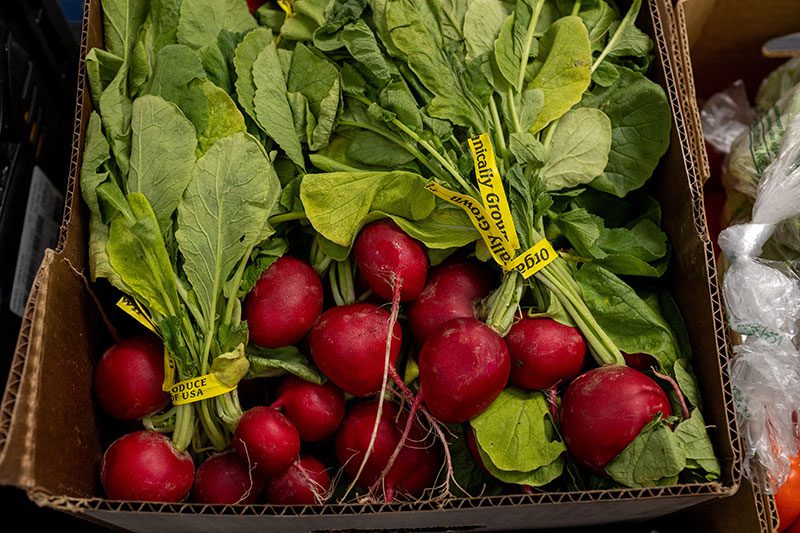
The delivery truck pulls into the warehouse driveway at the grocery-store-style facility. Vibrant murals on the exterior feature fresh fruits and vegetables, and they’re as abundant inside. The Growing for Good delivery includes crates of freshly-pulled bunched carrots with the greens still attached and hearty beets from Regino Farms, tender heads of Romaine lettuce and cilantro from The Crows Farm, bright red radishes harvested at LPM Farm and crisp sugar snap peas from The Dawn Farm, a new 2026 Viva participant. Growing for Good is a boon for Viva’s beginning farmers, who need reliable customers even as they’re starting out in the business.
Volunteers haul the boxes into the market, unload them onto the day’s display and then help clients making their way through the store, asking which vegetables they’d like and bagging those they choose.
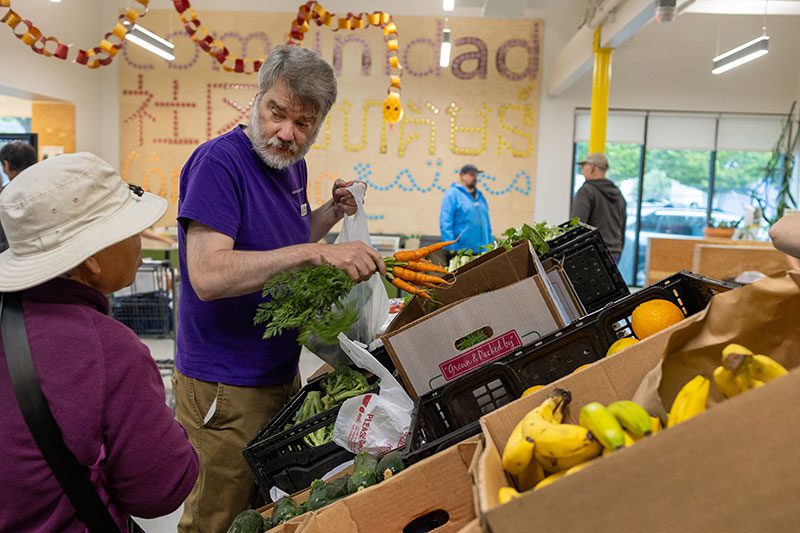
“We serve such a diverse community here. Parsnips don’t move here, and that’s about it,” said Michael Playford, the food bank’s director of operations. Culturally relevant foods are a particular focus. “Bok choy is the most popular thing we get,” Playford said. Green onions are popular too. Polling users, the food bank learned that fresh produce was their top priority.
The food bank is so busy, notes Playford, that Growing for Good items often plug holes in auxiliary programs like retirement home services or home deliveries rather than being spread across the 400 or so daily market visitors.
White Center is one of the few food banks to use some of its Growing for Good allotment toward Kirsop chickens and bone broth, a calculation that provides smaller quantities of a costlier product, but a large benefit for clients seeking nutritious proteins.
The food bank’s goal is to source 25% of its purchases from farmers who are Black, Indigenous and People of Color (BIPOC). About half of Growing for Good’s farm partners fit that category.
“We are, first of all, an anti-racist organization,” Playford said. “We want to do more than just say that we are, and recognizing that there needs to be some economic impact as well, and that’s one way we can do that, is supporting these farmers.”
But Playford also notes that “small farmers in general are really underrepresented” in the marketplace, and he wants to support them as a whole. He’ll ask what the Growing for Good farmers have available that they’d like to sell, rather than the more typical model of food banks planning out specific crops for the farmers to grow.
Some 100 volunteers help make the operation run smoothly. “We speak nine languages at the front desk. We have some intake staff who have been here for 20-plus years,” said Randy Nguyen, the food bank’s marketing and community engagement director. “We have customers who come from different zip codes just to come here, so that there’s no cultural barrier.”
Within an hour, as he spoke, the 96 bunches of fresh carrots each found a home.
Each farm and partner in Growing for Good has an individual story, but together their message is clear: A few pennies or dollars at a time, we can lay a table that supports us all.
Growing for Good week at Seattle Neighborhood Farmers Markets
Growing for Good Week is coming to Seattle Neighborhood Farmers Markets Sept. 8-13!
Stop by the Growing for Good booth to complete a scavenger hunt, win prizes, pick up merchandise, and learn more about supporting local farms and hunger relief. Look for the booth:
From 3 p.m. to 7 p.m. Tuesday, Sept. 8, at the Capitol Hill Farmers Market.
From 3 p.m. to 7 p.m. Wednesday, Sept. 9 at the Columbia City Farmers Market.
From 3 p.m. to 7 p.m. Sept. 11 at the Phinney Farmers Market.
From 9 a.m. to 2 p.m. Saturday, Sept. 12 at the University District Farmers Market.
From 10 a.m. to 2 p.m. Saturday, Sept. 12 at the Magnolia Farmers Market.
From 11 a.m. to 3 p.m. Sunday, Sept. 13 at the Capitol Hill Farmers Market.